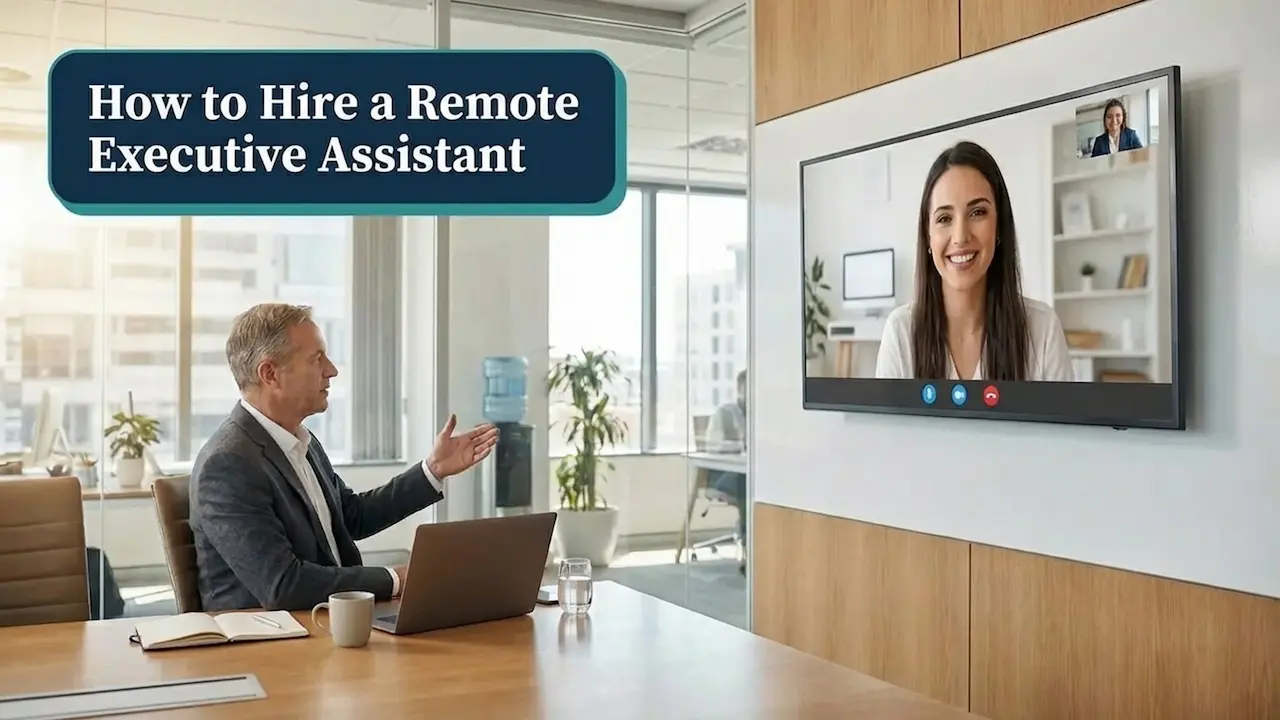
.avif)
.avif)

Executive Assistant Interview Questions: How to Identify Top Talent Before You Hire
Most executives google a list of interview questions the morning of the call, ask a few generic prompts, and decide based on vibe. Then they wonder why their new EA is underwhelming three months later.
Hiring an executive assistant is one of the most consequential hires you'll make. The person you choose will have access to your calendar, your inbox, your investor communications, and often your personal life. They'll make decisions on your behalf, represent you to clients, and be the first line of defense between you and everything that shouldn't reach you. Using the wrong executive assistant interview questions—or no structured process at all—is how you end up cycling through EAs every six months.
This guide covers the interview questions that actually predict performance, organized by the five skills that determine whether an EA will succeed in the role. Use it before your next hire.
Why Most EA Interviews Fail
The standard interview process was designed for traditional employment—testing a candidate's background, personality fit, and basic competency. For executive assistants, that process misses almost everything that matters.
They test the wrong things
Most hiring managers ask about past experience, organizational tools, and "how you handle stress." These questions aren't useless, but they don't tell you whether someone can manage your priorities when you're on a plane and three things are on fire. They don't reveal whether someone will write an email on your behalf that reflects your voice, or send something that embarrasses you.
What predicts EA success is judgment—the ability to make good calls without constant guidance. Experience is a useful proxy, but it's not the thing itself.
The three most common EA hiring mistakes
- Hiring for experience over judgment. Ten years as an EA at a Fortune 500 company doesn't mean someone can operate inside your specific context. The EA who thrived in a structured corporate environment may struggle in your fast-moving, ambiguous startup.
- Skipping the skills trial. Talking about what someone can do is not the same as seeing them do it. A quick practical task—drafting an email, reorganizing a messy calendar block, summarizing a document—reveals execution in a way no interview question can.
- Not defining "great" before the conversation starts. If you walk into an interview without a clear picture of what exceptional performance looks like, you'll optimize for likability. Likability is not a job function.
The 5 Skills That Predict EA Performance
Before you look at any question, anchor your interview around these five capabilities. Every question in this guide maps back to one of them.
1. Prioritization under ambiguity
Can your EA triage when everything is urgent and you're unreachable? This is the single most common failure mode for mediocre EAs. They escalate everything, or worse, freeze.
2. Communication precision
Can they write on your behalf without you having to rewrite it? Do they know when a three-line email is right versus a three-paragraph one? Communication isn't just a soft skill for EAs—it's the job.
3. Judgment and proactivity
Do they solve problems or hand them back to you? A great EA sees around corners. They notice the meeting that's poorly timed, the document that wasn't circulated, the conflict that's developing. They act before you ask.
4. Discretion and trust
Your EA will see things most of your employees never will—salary data, board dynamics, personal calendar. This isn't trainable once the wrong person has access. It needs to be present from day one.
5. Async excellence
Especially for remote EAs: can they operate effectively across time zones without needing constant check-ins? Do they document decisions, update systems, and communicate status proactively?
30+ Executive Assistant Interview Questions by Category
Use these questions to structure your interview around the skills above. Each section includes guidance on what a strong answer actually looks like.
Prioritization and Time Management Questions
- Walk me through how you manage your principal's calendar when three things need to happen at the same time and they're unavailable.
- Tell me about a week where everything went sideways. How did you decide what got your attention first?
- You have 47 unread emails in the inbox you manage. It's 9am. What's your process for the first 30 minutes?
- Your executive is on a flight and a stakeholder calls asking to escalate a decision. You can't reach anyone above you. What do you do?
- How do you decide what to handle independently versus what to escalate?
What a strong answer looks like: The candidate describes a system, not a feeling. They explain the criteria they use to triage—urgency, reversibility, who else is affected. They demonstrate that "I don't know" is never the end of the story for them. Weak answers sound like: "I just stay calm and handle it."
Communication and Writing Questions
- Draft a one-paragraph email on my behalf declining a board meeting invitation due to a scheduling conflict. I'd like to reschedule.
- When do you write a long response versus a short one? Give me an example of each.
- You've been asked to send a sensitive message to a client on behalf of your executive. You disagree with the tone. What do you do?
- Tell me about a communication breakdown you were responsible for. What happened and what did you change?
- How do you handle it when someone writes to your executive with an urgent request and your executive has said they don't want to engage with that person?
What a strong answer looks like: In Q6, look for appropriate tone, a clear reason, and a proactive reschedule offer. Strong candidates demonstrate voice-matching, audience calibration, and the courage to flag disagreements through the right channel rather than silently comply or unilaterally override.
Judgment and Proactivity Questions
- Give me an example of something you solved before your executive knew it was a problem.
- Your executive keeps missing a weekly sync with their COO. They haven't mentioned it, but you've noticed. What do you do?
- You're prepping a travel itinerary and you notice the return flight gets in 90 minutes before a major client call. What happens next?
- What decisions do you believe an EA should make autonomously, and where should they always escalate?
- Tell me about a time you pushed back on your executive. What was the situation and how did you handle it?
What a strong answer looks like: These questions reveal whether a candidate is reactive or proactive. The best EAs don't wait for permission to notice things—but they also know the difference between a decision that's theirs to make and one that belongs to their principal.
Discretion and Trust Questions
- What's the most sensitive information you've handled in a professional role, and how did you protect it?
- Your executive's spouse calls looking for information about a travel booking you have access to. How do you handle it?
- A colleague asks you what your executive thought about a recent board meeting. How do you respond?
- How do you handle it when you disagree with something your executive is doing, but it's clearly not your call?
- What does confidentiality mean to you in practice? Give me a specific example of how you've demonstrated it.
What a strong answer looks like: Look for candidates who treat discretion as an instinct, not a policy they've memorized. The best answer to Q17 isn't "I'd ask for permission"—it's "I would never share information without explicit authorization from my executive, and I'd let them know the call came in."
Async Work and Remote Capability Questions
- What does a good end-of-day summary to your executive look like? Walk me through what you'd include.
- How do you track your own work when there's no manager checking in?
- You're working async with an executive in a different time zone. A decision needs to be made before they wake up. Walk me through your process.
- What tools do you use to stay organized, and how do you decide which tool to use for which type of task?
- You're 8 hours ahead of your executive. A meeting they need to prepare for starts in 2 hours. They haven't seen your prep doc. What do you do?
What a strong answer looks like: Remote-capable EAs have systems. They can describe exactly how they communicate status, how they escalate asynchronously, and how they handle time-sensitive decisions. Red flag: candidates who describe async process as "I just message them and wait."
Beyond Questions: How to Run the EA Interview Process
The questions above are only one part of an effective process. Structured interviews alone are not enough to identify a top-performing executive assistant.
The structured skills trial
Before making any offer, assign every finalist a practical task. Keep it to 60–90 minutes of actual work, and compensate candidates for their time—it signals that you take the role seriously.
Strong skills trials include:
- Draft an email on my behalf declining a meeting with grace and a rescheduling offer
- Reorganize a messy calendar block given three competing priorities and a set of constraints
- Summarize a long document into a 5-bullet brief with recommended action
- Write a response to an ambiguous inbound from a client using the context provided
What the trial reveals that questions can't: execution quality, communication style under pressure, how they interpret ambiguity, and whether their judgment matches what they said in the interview.
Reference call questions that actually matter
Standard reference calls are useless because no one gives a bad reference. Ask these instead:
- "What did [candidate] handle that genuinely surprised you?" — reveals range you won't expect
- "Was there anything they were reluctant to own?" — surfaces limits they won't self-report
- "Would you hire them again without hesitation?" — the only yes/no that tells you anything
Follow the silence. The pause after "without hesitation?" is often more informative than the answer.
What Oceans Talent does differently
Running a rigorous process takes weeks and requires significant effort—behavioral assessments, skills trials, multi-round interviews, reference validation. That's before you've onboarded anyone.
Oceans Talent handles this process before you ever speak to a candidate. Every Diver on the platform has already passed a multi-round behavioral interview, a practical skills assessment, a communication evaluation, and reference validation. You get to start at the finish line.
Pro Tip: The best EAs don't need micromanagement. But they do need to be identified correctly before you hire them. The upfront investment in a rigorous process pays back in compounding productivity gains.
Red Flags to Watch For
In addition to what candidates say, watch for these behavioral signals throughout the interview:
- Vague, adjective-heavy answers — "I'm very organized," "I'm great with people" — without concrete examples
- No system for prioritization — just vibes or "I handle whatever comes up"
- Can't articulate what they'd do autonomously versus escalate — suggests over-reliance on direction
- Reluctant to give an opinion in any scenario question — EAs who won't push back in an interview won't push back when it matters
- Never asked a question about you or the role — low curiosity is predictive of low initiative
- Describes all past executives as difficult — a pattern, not a coincidence
FAQs
What are the most important qualities to look for in an executive assistant?
Prioritization, communication precision, judgment, discretion, and async excellence are the five qualities that most reliably predict top EA performance. Years of experience and tool familiarity matter less than these core traits.
How long should an executive assistant interview be?
A rigorous EA interview process takes three to five hours across multiple rounds: a 30-minute screening, a 60-minute behavioral interview, a 60–90 minute practical skills trial, and a reference call. Compressed processes tend to produce poor hires.
Should I hire an executive assistant through an agency or independently?
Both can work, but the process is very different. Hiring independently gives you control but requires a rigorous DIY vetting process—the kind described in this article. Working with a specialized service like Oceans Talent means candidates have already been through behavioral assessments, skills trials, and reference checks before you speak with them, which compresses your timeline and improves signal quality.
How do I test an executive assistant's writing skills?
Ask them to draft something during the interview or as part of a take-home skills trial. Give them context, a clear output requirement, and a time limit. Evaluate for: accuracy to the brief, tone calibration, appropriate length, and whether they anticipated anything you didn't spell out. Writing quality in the task will closely predict writing quality on the job.
What's the biggest mistake executives make when hiring an EA?
Optimizing for likability over capability. A candidate who's warm, enthusiastic, and easy to talk to is not necessarily someone who will manage your priorities effectively under pressure. Use structured questions, a skills trial, and reference calls to validate the impression—don't let a great conversation substitute for a great process.
Your Next Step
Running a complete EA interview process—behavioral screens, skills trials, reference validation—takes weeks and requires expertise most hiring managers don't have. The cost of getting it wrong is months of underperformance and a painful restart.
Oceans Talent has already done it. Every Diver on the platform has been evaluated using the same framework described in this guide, and then some. When you connect with an Oceans Talent EA, you're starting with someone who has already proven they can operate at the level your role demands.
Ready to skip the 30-interview gauntlet? Hire an Executive Assistant through Oceans Talent
.webp)